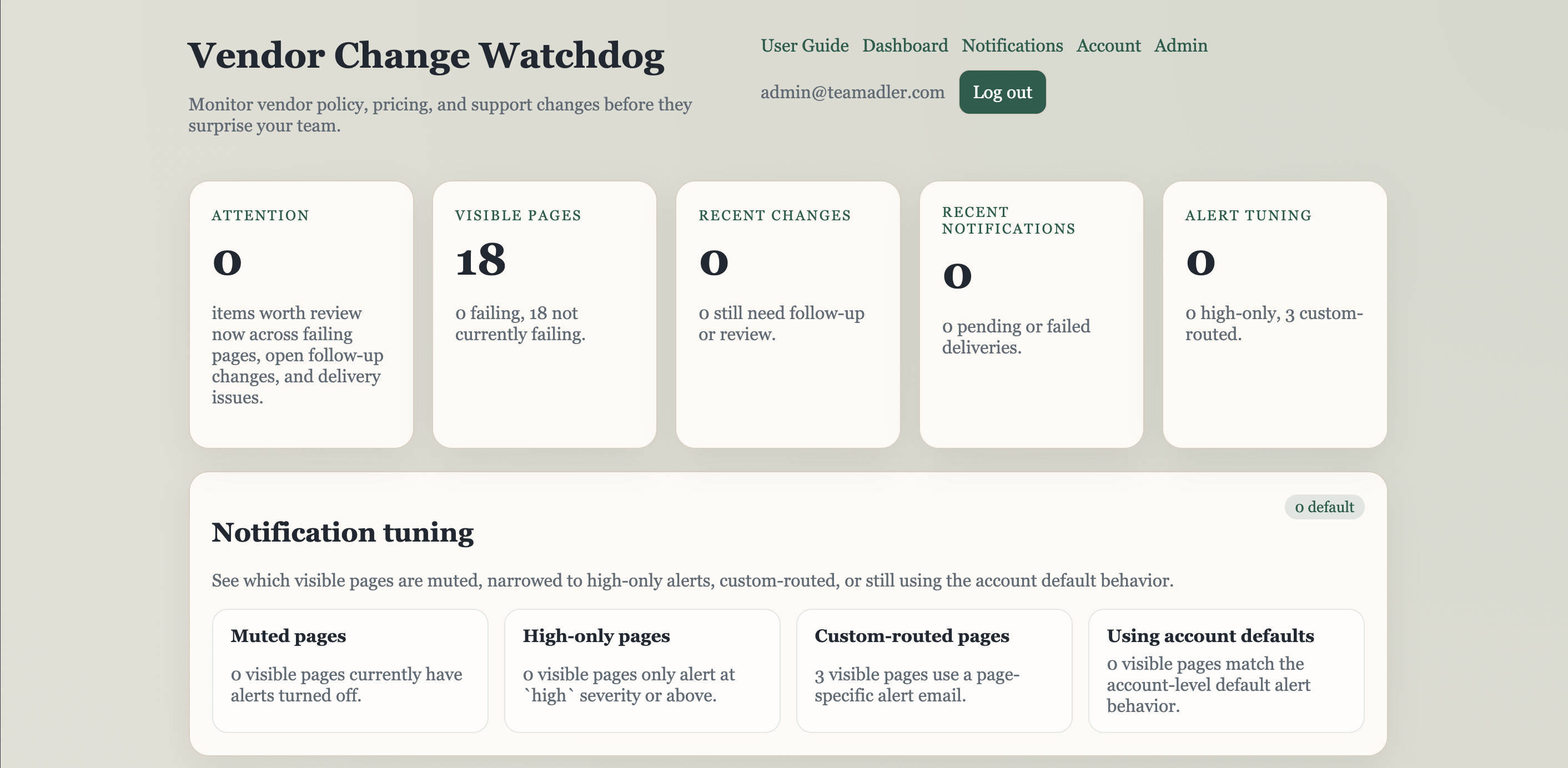
Dashboard summary
High-signal summary cards plus notification tuning posture on the same screen.
Vendor Change Watchdog monitors the specific pages your team depends on, stores clean before-and-after snapshots, and surfaces the language changes worth a real review. Use it for privacy, pricing, support, and other policy-heavy pages that rarely announce themselves when they move.
These previews mirror the actual workflow: a dashboard that surfaces what needs attention, and a change-review screen that keeps the evidence close to the decision.
High-signal summary cards plus notification tuning posture on the same screen.
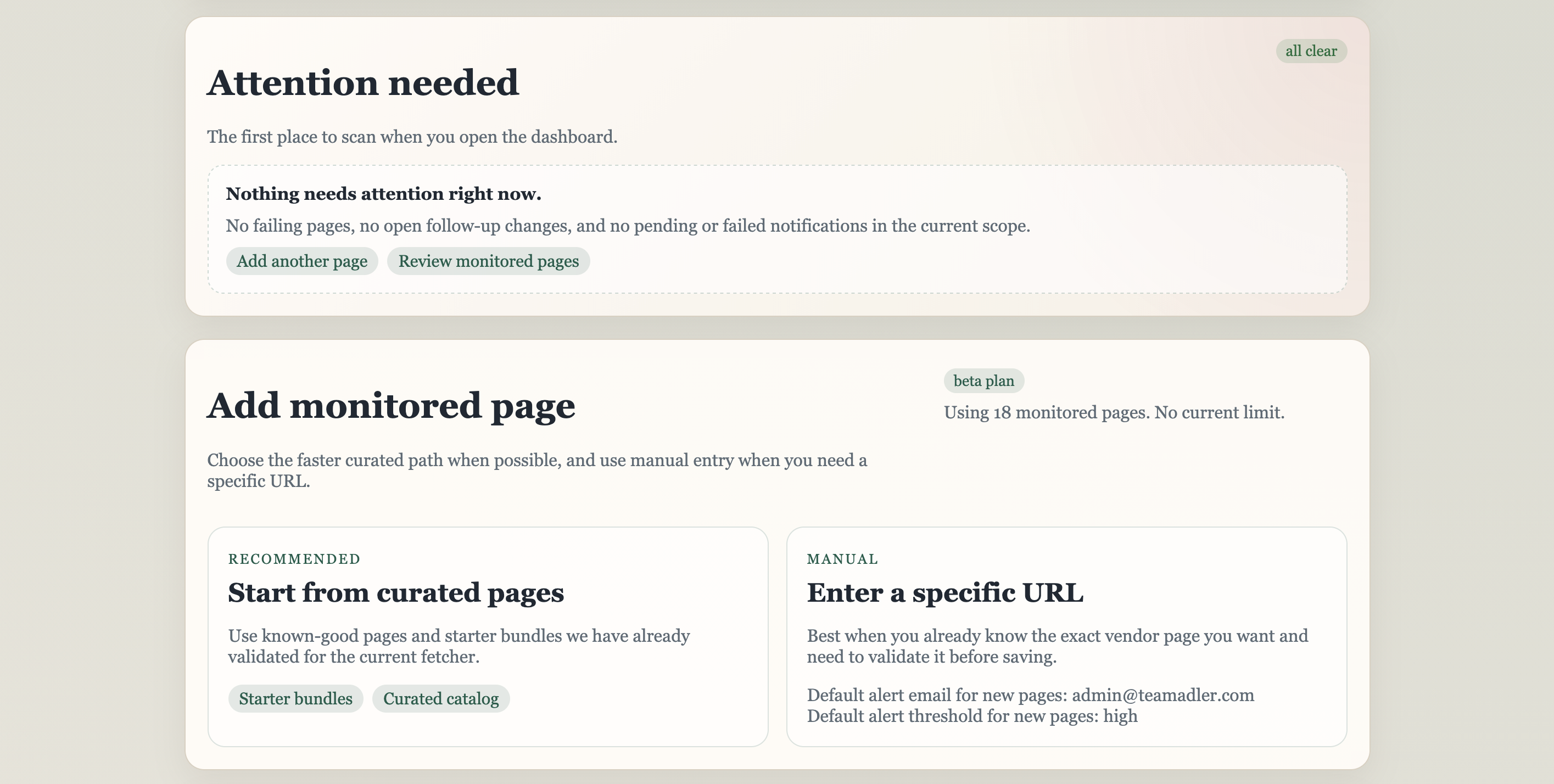
A first-screen triage section followed by a guided choice between curated pages and manual entry.
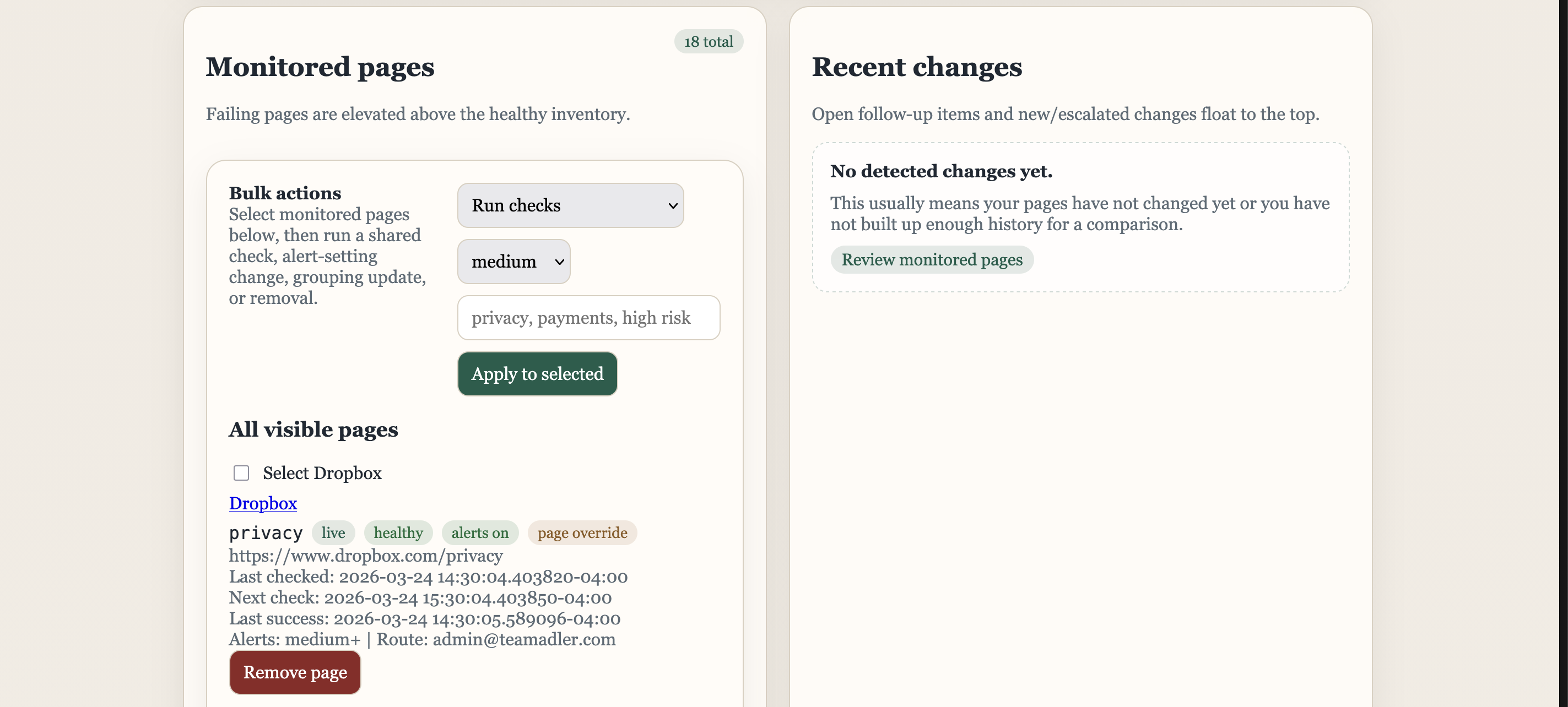
Bulk page actions, page grouping, and recent-change triage from the main dashboard.
We may retain service data for as long as necessary to provide support.
We may retain service data and related usage records for analytics, security, and model improvement.
Structured summary: the vendor expanded how retained data may be used after collection.
Existing operators can review current monitors while new public account and manual URL intake remain closed.
A diff gate and structured analyzer classify changes by severity and category, with supporting evidence and old/new excerpts for human review.
Account defaults and per-page overrides let you mute low-value pages, raise severity thresholds, or route important pages differently.
Existing operators can continue reviewing current data. Public signup and arbitrary manual URL monitoring are closed.
Public intake is paused; existing operators can continue reviewing their current watchlists.
When a qualifying change appears, the product gives you structured summaries, evidence excerpts, and stored snapshots.
Raise severity thresholds, mute noisy pages, or route sensitive monitors differently as the watchlist matures.
Track support, roadmap, and vendor-policy changes that affect delivery and operational risk.
Watch pricing pages, entitlements, and support terms that can shift cost or coverage.
Review data terms and policy language without diffing pages by hand.
Vendor privacy policy, data processing terms, retention statement, AI usage or training language.
Pricing page, support plans, SLA language, entitlement documentation, plan comparison pages.
Support commitments, service limitations, documentation that affects integrations, onboarding, or coverage.
The current public plan shape is simple: a self-serve free account for initial monitoring, a larger starter tier, and higher-capacity plans for broader vendor inventories.
Up to 3 monitored pages with the full review flow, alerts, and dashboard.
Up to 10 monitored pages for teams that need broader coverage without heavy setup.
Up to 25 monitored pages for deeper coverage across privacy, pricing, support, and policy pages.
This product exists to shorten the time between a vendor changing something important and someone on your team seeing the exact language clearly enough to review it and decide what to do next.
That is enough to see whether the validation flow, snapshots, change review, and alert tuning are useful before you invest in a larger watchlist.
The public docs are organized around product fit, practical usage questions, service posture, and baseline legal information.
Best for figuring out what the service does, who it helps, and how the plans currently map to usage.
Use these when you want current service posture, support contact, or a way to report an issue.
Use these for service privacy handling, account expectations, and basic usage terms.